Space Systems Engineer · ML Engineer · Physicist
Rodrigo Schmitt
Advancing space exploration through AI, computational design, and systems engineering.


Advancing space exploration through AI, computational design, and systems engineering.
Co-Founder & CCO at Stellerian — AI-enabled satellite navigation.
Now
Co-Founder & Chief Commercial Officer at Stellerian — AI-enabled satellite navigation. $1.8M in government contracts, $600k in private investment, $69M in customer LOIs, Techstars Space Accelerator 2025.
Education
PhD, Aeronautics & Astronautics, Purdue (2025).
MSc Space Engineering, National Institute for Space Research (2021).
BSc Astronomy & BSc Physics, University of São Paulo (2019).
Research
Generative design of space systems with Reinforcement Learning & Explainable AI.
Computer-vision spacecraft navigation for precise rendezvous & proximity operations.
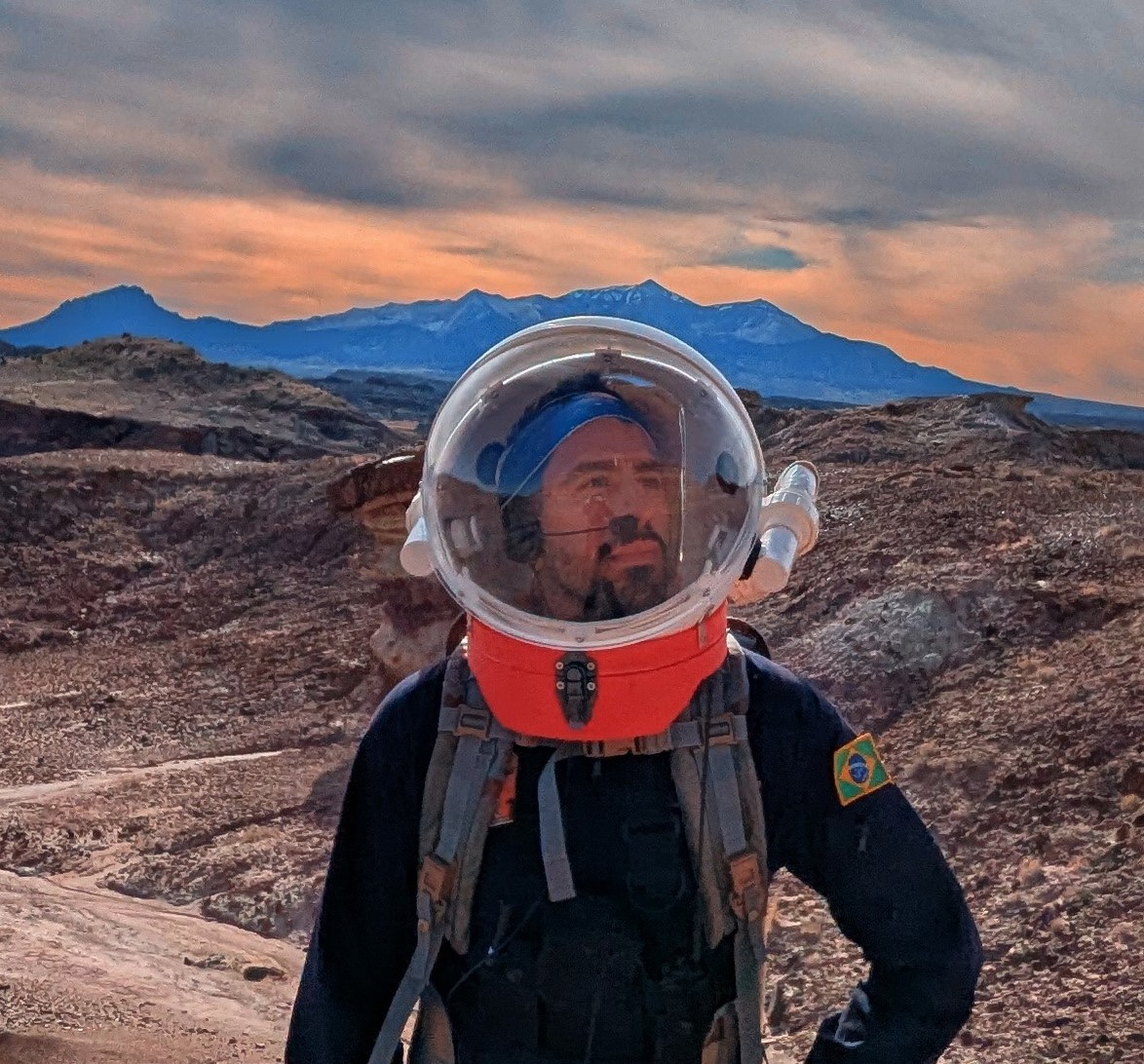
Drone-LIDAR Mars EDL research as an analog astronaut at MDRS.
Co-founder of RocketPy, a 6-DOF rocketry simulator with thousands of users.
About
Hi! I am Rodrigo Schmitt, a Space Systems Engineer, ML Engineer, and Physicist from Brazil, dedicated to advancing space exploration through AI, computational design, and systems engineering. I hold a PhD in Aeronautics & Astronautics from Purdue University (2025), where I researched AI-driven space mission design at the Center of Integrated Systems in Aerospace under Prof. Daniel DeLaurentis, supported by the Ross PhD Fellowship and Bilsland Dissertation Fellowship.
My doctoral research explored the generative design of space systems using Kerbal Space Program with the Realism Overhaul mod to simulate Artemis-era spacecraft and System-of-Systems mission architectures. I applied Reinforcement Learning, Explainable AI, and the Circular Restricted Three-Body Problem to novel mission concepts — producing publications in Acta Astronautica and Aerotecnica Missili & Spazio (2025) and presentations at the IAC, AIAA SciTech, and IEEE Aerospace Conference. My expertise spans astrodynamics, hands-on hardware development, and artificial intelligence for space applications.
Today I channel that research foundation into building a company: as Co-Founder & Chief Commercial Officer at Stellerian, I have secured $1.8M in government contracts and $600k in private investment, helped build $69M in strategic Letters of Intent for our AI-enabled satellite navigation subsystem, and completed the Techstars Space Accelerator (2025). I also co-founded RocketPy, a widely used Python rocketry simulation library with thousands of users. My hands-on field experience includes integrating Drone-LIDAR systems for Mars terrain mapping as an analog astronaut with MDRS Crew 306 at the Mars Desert Research Station. Earlier, I led Purdue SEARCH, the university's first dedicated human space exploration chapter, re-kindling analog astronaut training and fundraising $24k.
Philosophy
I believe that a solid foundation in fundamental sciences is key to solving complex engineering challenges. My background integrates physics, mathematics, coding, and hands-on hardware development as essential tools for tackling the future of space technology.
Featured Projects
Astrodynamics
Artemis-era mission design in Kerbal Space Program + Realism Overhaul, trajectory optimization, and multi-body dynamics in the CR3BP.
- CR3BP
- Trajectory Design
- Rendezvous & Prox-Ops

Deep Learning & AI
Generative design of space systems via Reinforcement Learning, Explainable AI for mission trade-offs, and computer-vision spacecraft navigation.
- Reinforcement Learning
- XAI
- Computer Vision
Design, Build & Test
RocketPy, carbon-fiber rocket structures, LIDAR-drone integration for Mars EDL research, and analog astronaut fieldwork at MDRS.
- RocketPy
- LIDAR
- Analog Astronaut